Saturday, April 30, 2011

Audubon & Bluebirds

As promised, here is the last of the updates on current hot topics here at Winchester. Many have noticed that some bird boxes have been installed around the course. These boxes are designed and installed specifically for bluebird nesting, although they sometimes are used by other small birds like tree swallows and house wrens.

Building, installing and monitoring these boxes has long been a personal passion of mine and, fortunately, the property of Winchester and the values of ValleyCrest lend themselves perfectly to continuing this hobby. We at ValleyCrest encourage every property we become partners with to participate in the Aububon International Cooperative Sanctuary Program for Golf Courses. Involvement in this certification program by no means obligates a course to become 100% organic, or go "all green", but merely provides helpful resources, guidelines and assistance in encouraging courses to become more aware of their maintenance practices' interactions and effects on the environment and wildlife habitats. In all honesty, most all superintendents I know love and respect nature and the environment (it's why most of us have these jobs in the first place!) so participation in this program is often occurs naturally and with very little extra effort.

Part of the Audubon certification process is to complete some environmental and wildlife-related projects on the course. Building and monitoring these bluebird habitats fit that niche perfectly. During the winter, while stuck inside during rain storms, we built 9 boxes to start with. They were installed about a month ago, and you can see already that Winchester's birds have taken a liking to them.

This box is located on #17 near the maintenance building. We build these side doors for easy monitoring and you can see a bluebird nest here is nearing completion.

And as of this morning, the box on the driving range near the pitching green already has the start of a family! The mama bird was sitting on these eggs as I opened it, but flew away before I could get a picture.

We'll continue to provide you with updates on the birds and these boxes, as well as other parts of the Audubon certification program that we will continually be working on.

Monday, April 25, 2011

Battling Poa

As promised, here's the update on the next hot-button topic here at Winchester: Poa annua (also know as Annual Bluegrass), and what to do about it. As I'm sure many people know, this battle is raging on golf courses across the US. And few, if any, have been largely successful at taking down the enemy. In fact, many have simply chosen to embrace it, and nurture Poa to become a decent, sometimes excellent, playing surface on it's own.

However, we still have enough of the originally intended grass for our putting surfaces, bentgrass, that it makes the fight still worth fighting. Bentgrass is optimal not merely as a more consistent, smoother putting surface, but also from a management standpoint, as it tends to need less water, less fertilization, and is susceptible to fewer diseases (in this part of the country) than Poa. So the war battles on....

A key part of our Poa management strategy is chemical control through growth regulation. We use two plant growth regulators (Trimmit and Primo) to help us give the bentgrass a competitive edge over the Poa. So far this year, we've made two applications of this mix, and you can begin to see some mild results already:

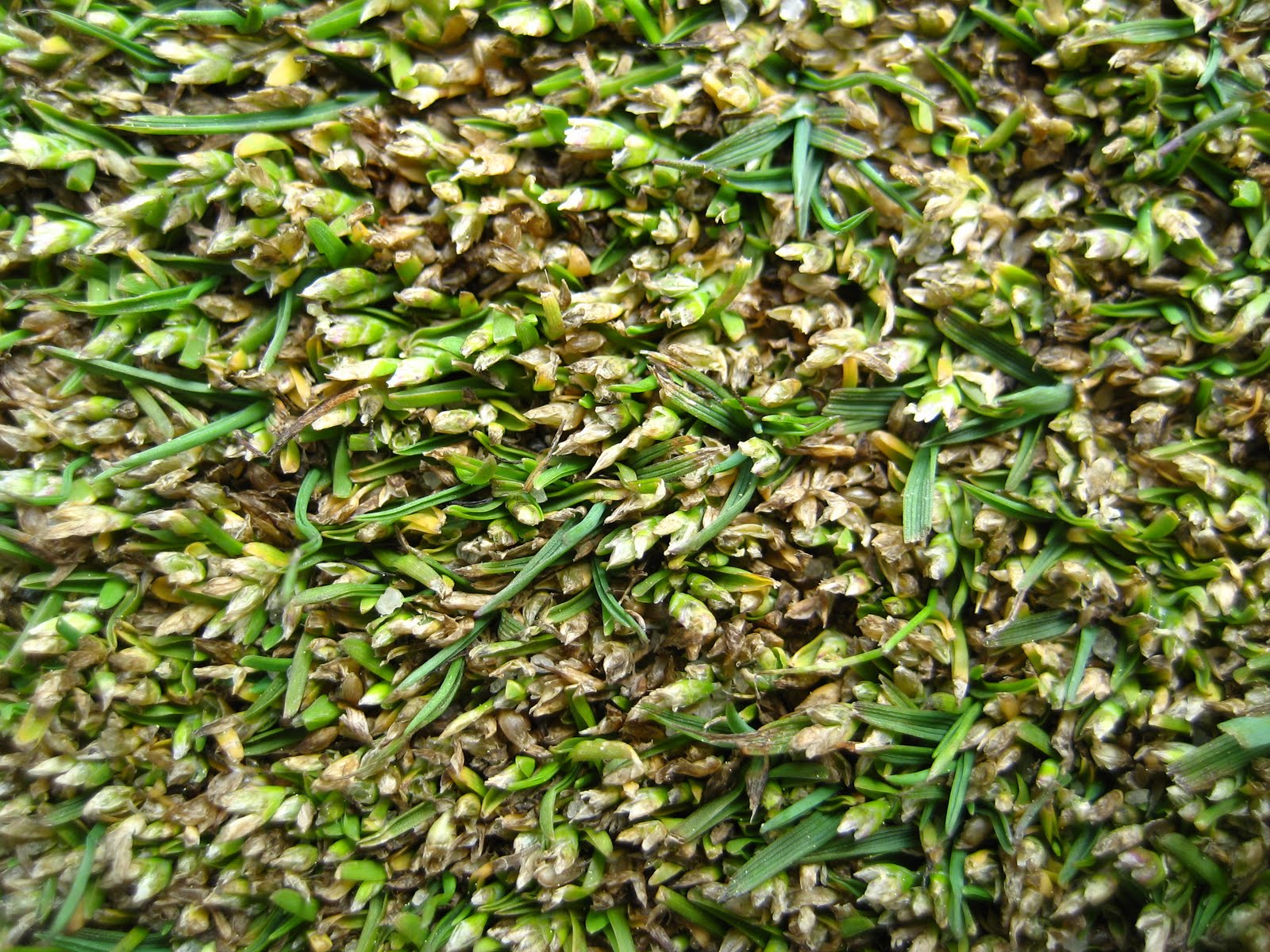
#18 Green: A very obvious visual - the Poa really stands out here, partly from the production of seedheads (which come out in a flush as the plant gets stressed, and cause alot of bumpiness that golfers really don't enjoy) as well as the yellowing and browning cause by the growth regulator itself.

Here's a bit closer showing the selectivity of the growth regulators: healthy bentgrass surrounding a really stressed out and stunted patch of Poa.

And even closer....this is what we're looking for. The lighter green, short blades with attached brownish seedheads is the Poa, stunted and tight. But the longer, greener blades of bentgrass are poking through. So even as the Poa may not completely die out, we hope to see this bentgrass continue to growth, thrive and push through and over the Poa to choke it out and leave us only with our most desired grass.

This is definitely not a process that occurs overnight. It's a long and difficult road. But combined with other management practices that favor bentgrass over Poa, we hope to beat back the current population and attempt to revert the greens to bentgrass, to the best of our ability. Stay tuned for other ways that we manage to give bentgrass the competitive edge in future posts. And for the last hot-button topic: bluebird boxes and Audubon!

Friday, April 22, 2011

Drainage Quick Fixes

It's been some time since our last post, but it's not for lack of things to post about. In fact, just the opposite....we've all been so busy there's been no real time to sit down and punch out an update!

But as we get busier, we understand that these updates and educational posts are even more important to our members and customers. So allow me to catch you up on the three most talked about aspects of the course at this moment. We'll start by dedicating this post to the first: drainage.

The course has dried out beautifully in between the now sparser rain storms...except for a few very obvious areas: #3 approach, #4 blue tee and #8 fairway. After much investigation and exploration, we're at a loss to pinpoint where this water is coming from to be able to control it from the exact source. It seems to be seeping out the hillsides everywhere. So while we explore some more permanent and long term solutions, so we don't end up dealing with this problem areas every spring, we've gone to work on some rough, generic, but effective drainage solutions.
After digging this huge hole to investigate the irrigation mainline, nothing was found leaking, and the water continues to fill the hole from elsewhere. A drain  has now been installed from this seepage point down the entire approach, and another in the right rough about 50 yards out. Both should dry this area out and provide better turf conditions.

Though not very obvious in this picture, the back right corner of this tee has about 1/2" of water sitting on it. We've since put in a drain around this corner to catch the water and divert it around the tee. The tee is already much drier and we've been able to finally mow the whole thing.

#8 fairway is by far the worst problem. Water seeps out of severl locations along the right rough, as seen in this picture, and runs along the turf surface through large portions of the fairway landing area. Despite many existing drains in this area, the water continues to cause a problem. Here we've since cut a trench along the rough line to stop the water from reaching the fairway and diverted it to a functioning drain we found. With a few days of sun, the fairway should dry out enough for us to mow and begin getting it back into much more playable condition.

Thank you for your patience with these projects, and keep checking back for updates on a more long-term solution that we've begun looking into. Also check back soon for updates on two other hot-button topics: Poa control and new bluebird nestboxes. More coming soon!

Friday, March 25, 2011

Winter Storm Update

Just when most of us hoped that winter was nearing a close, we've been again put to the test the past two weeks. Here's the data: 11.7 inches of rain in the last 12 days (only one day without any rain), with a little bit of snow mixed in. And here's the damage: 

Bunkers are washed out throughout the course. With this much rain it's inevitable, but we hope to have them completely rebuilt and playable by the middle of next week, after the rain stops. It will take about 5 guys almost two full days to tend to every bunker, so it's pointless to attempt the clean-up until the rain stops for a good few days. Please play these hazards as ground under repair until we're able to get to them.

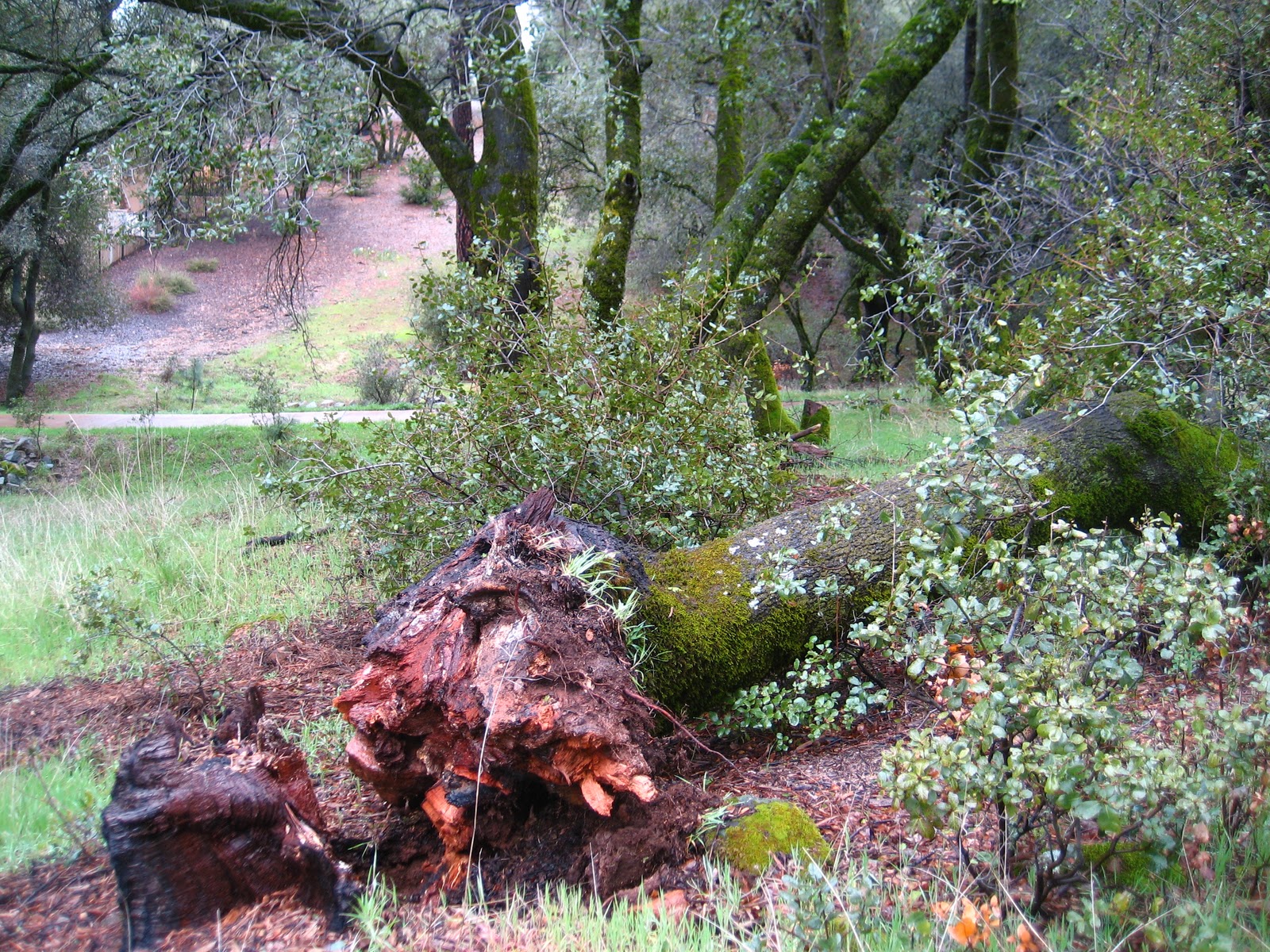
Fortunately, only two trees came down in mostly out of the way locations. Here's an oak that fell across the path on #10 near the crossing on Lodgeview.

And the other fell near the pump house on #11, also blocking the path. Both paths have been cleared and the trees will eventually  be cut up for firewood.

The walking bridge on #10 washed out and the rocks have become very unstable. We can fix this quickly, but a more stable, long-term fix will eventually be needed here as this happens almost every time we get significant rain.

The good news is that nothing disastrous has happened over the course of the storm, and the end is in sight, with sun and temperatures climbing back into the high 60s forecasted as early as Sunday. The course will be wet, and a little shaggy until we can get all our equipment out to mow, but we plan on having everything looking and playing great by the end of next week!

Sunday, March 13, 2011

Winter Projects


As the winter draws to a close, I thought I'd highlight a couple of the most recent improvements made on the course as part of our "winter chores."


This is a drain I'm sure most who've played lately have noticed. It was dug in attempt to capture water that seems to be mysteriously seeping out of the hill to the right of #3 and making the approach and right fairway constantly wet and unplayable. As we've surely caught some of the problem (easily judged by the steady flow of water in this trench), you'll probably see at least one more drain go in in this area to try to dry up the problem for good. This trench will have a pipe installed and be back filled with gravel within the next week.


We've slowly been reinstalling the path yardage markers that have broken off over the years. So if you see cones on the path, know that they are only there for 24 hours to protect these markers as the adhesive cement dries and please drive around them. Hopefully this time they'll stick for good!


And the most recent improvement was with a new set of putting green flag sticks on the main putting green near the driving range, complete with numbering (for those of you who wish to make a game out of your practice) and Winchester logo. Matching the flag sticks on the course, they're a nice upgrade to this popular area.

Thursday, March 10, 2011

Patience Pays Off

We've received alot of questions lately, as the weather has become more conducive for regular golf, about the conditioning of the greens. Specifically:

- What are those green splotches, and when are you going to do something about them?
- The greens are slow...when will they be faster?
- When will the areas sodded last fall be less spongy?

There are many answers and long explanations to go with each of these questions, but the simple and best answer is: When it's time.

It's tough this time of year to be patient. The sun is out, flowers are blooming, everyone can sense things in nature starting to wake up. And it's the same with our grasses. We have very well thought out plans in place, ready to enact, to combat our issues and improve the courses' playability. But we have to be patient. Because the majority of our plans involve getting aggressive and doing some form of temporary damage to our greens, either by verticutting, aerating, lowering mowing heights, chemical applications, sand topdressing, etc. And the last thing anyone wants is to do damage to the greens, even for the sake of making them better in the long run, and to run into some temperamental weather and have to wait far too long for the grass to grow out of the injury inflicted on it.

Think of it like this: if you start feeling "under the weather" in the winter, maybe you catch a fever, a cough, you just don't feel yourself. You can tell your immune system is a little compromised. So is our grass's growing ability slightly compromised by the colder weather. And if you stay home and get rest and eat well, perhaps you feel a bit better after a day or so. But if you get impatient, and go out and push through 36 holes of golf in a day, you'll more than likely end up right back in your bed, feeling miserable. Whereas if you just waited another day or two to make a full recovery, you'd be able to pull of 36 holes AND shoot below your handicap!

Our grass is slowly waking up, and while it's not quite at 100% recovery yet, if we're patient just long enough, we can be as aggressive as we want, and the grass will pull through with shining colors and be all the better because of it.

Wednesday, March 2, 2011

Winchester Webcam

A brilliant idea by the staff and management here at Winchester, a webcam has recently been installed to look down over the clubhouse putting green, #10 and 18, and provide often spectacular views of the Sacramento Valley floor below. You'll find a small picture of the most up to date webcam picture in the right margin of this blog, and clicking on that picture will take you to the dedicated webcam page and a larger view.

So check back regularly for the best snapshot of up to date conditions here at Winchester....no need to trust those weather people when you can log on and check for yourself!!